


Retaining Walls or Regrading in Watkinsville and Monroe
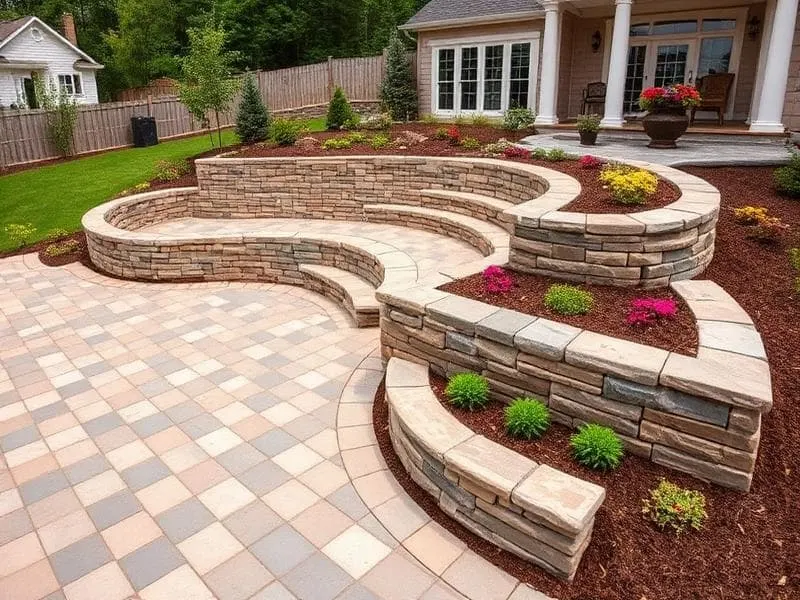
If soil has to be held in place to make a change in grade stable, a retaining wall may be needed. If the ground just needs reshaping so water and use work better, regrading is often enough. For retaining walls in Watkinsville, Georgia, and across Monroe, the choice often involves factors such as how big the grade change is, where runoff goes, and whether the soil will stay put on its own.
When a retaining wall fits the problem
A retaining wall is a structure that holds soil back where the ground steps up or down. Think of a bank that keeps sliding toward a patio, or a slope too steep to mow, plant or walk. The wall carries the load of that soil so the grade stays where you put it.
A wall can also create a flatter area for a patio, play space or driveway edge where reshaping the surface alone would not hold. Without support, a steep cut or fill tends to slump over time, especially after repeated heavy rain.
One limit matters here. A wall does not solve the source of water. If runoff flows toward or through the soil behind it, that water pushes on the wall and can undercut it. Retaining wall planning generally includes drainage.
When regrading may be enough
Regrading means reshaping the ground surface. A crew cuts, fills and smooths so the surface slopes the way you want, often to guide runoff away from a house, a patio or a low spot that stays soggy.
It suits a gradual slope that does not need soil held back. If the ground is stable and the main complaint is standing water or runoff in the wrong place, moving soil and resetting the slope can fix it without building anything.
The key difference is this: regrading changes the surface, while a wall supports a steep grade. Pushing a steep bank into a gentler one can work if you have room. If you do not have the room, or the bank is tall, reshaping has nowhere to go and a wall is usually the answer. Our site preparation and grading crews handle the reshaping side, and excavation comes in when soil has to be cut out, moved or hauled off first.
Side by side
| Factor | Retaining wall | Regrading |
|---|---|---|
| Size of grade change | Steeper or taller changes that need support | Gentle slopes with room to reshape |
| Soil behavior | Soil that slumps or slides if left alone | Soil that is stable once the surface is reshaped |
| Runoff | Needs drainage planned behind and around the wall | Can redirect surface flow away from a problem area |
| Usable space | Gains a flatter area in a tight footprint | Needs enough width to ease the slope |
| Scope | Built structure plus base and drainage | Earthwork across the area |
Runoff and Georgia winter conditions
Georgia winters, usually December to February, can bring freezes. Where soil freezes and thaws, wet ground can swell and push against a wall, then loosen as it warms. A wall with water trapped behind it carries more stress than one that drains.
That is why drainage behind a wall matters. Walls commonly use gravel backfill and a way for water to exit so it does not build up behind the face. Runoff should be considered before choosing either approach, because a wall built without a plan for water can fail where good regrading would have sent the water elsewhere.
Conditions vary by lot in Watkinsville and Monroe. If your yard is clay, it may hold water longer after storms and drain slowly. If your lot sits below a neighbor's yard or a road, more water may arrive than falls on your own property. Observing your site after rain may help clarify how water moves. If your project involves a taller wall, check with your city or county about permits.
What to check before choosing
You can gather some useful site observations yourself. Walk the area during or just after a good rain and watch the water.
- Note where runoff travels, where it enters your yard and where it leaves.
- Look for soil that is moving, washing out or collecting at the bottom of a slope.
- Measure the length of the area that needs attention and roughly how much the ground rises or drops across it.
- Check for existing features nearby, such as a foundation, a driveway edge, a septic area or trees, that limit what can change.
- Take notes and phone pictures from the top and bottom of the slope.
Those observations let you talk through whether retaining wall work or grading better fits the site. Often the answer is both: a wall where the grade is steep and regrading to carry water around it.
Common questions
When does a yard need a retaining wall?
A yard usually needs one when a grade change is steep or tall enough that the soil will slump or slide without support, or when you need a flat area that reshaping alone cannot hold. If the slope is gentle and stable, regrading may be enough.
Can regrading fix a sloped yard without a wall?
Sometimes. If there is room to ease the slope and the soil stays stable, reshaping the surface can redirect runoff and make the yard usable. A steep bank in a tight space generally calls for a wall.
Does a retaining wall need drainage?
Yes. Water that collects behind a wall adds pressure and can cause movement, especially where winter freezes occur. Gravel backfill and an outlet for water are common ways to keep it from building up.
Areas we serve
Our services
Have a question about your project? Call (470) 497-9955